Posted on

Final call for OM System Tell Your Story II submissions

OM System Tell Your Story

You only have until 25th March!

Last year’s Tell Your Story Program was a big success. It’s an initiative designed to help OM System discover and support new talent. Those lucky enough to be selected are provided with their own OM System OM-5 kit, plus the personal mentorship of a nominated OM System Ambassador.

You have until March 25th, 2024 to enter: photography enthusiasts of every skill level are invited to participate in Tell Your Story II. The project will be primarily showcased on Instagram, utilizing the @omsystem.generation channel, curated for newcomers to the photography community. The content will embrace both inspirational and foundational technical insights associated with the OM-5 and M.Zuiko lenses. Additionally, the campaign will be promoted through posts and stories on Instagram, TikTok, and YouTube Shorts.

“We’re excited to bring back Tell Your Story with Tell Your Story II, building upon the success and momentum of last year’s program,” said Mark Thackara, Senior Manager of Content and Community at OM SYSTEM. “This year, we’re delighted to collaborate again with our esteemed photography mentors from around the world, including Julia Wunsch, Rania Ronntöft, Daniel Villadsen, Brooke Bartleson, and Peter Baumgarten.”

In addition to the familiar mentors, Tell Your Story II introduces a new theme inspired by the timeless Japanese philosophy of Kacho Fugetsu, which translates to “Flower, Bird, Wind, Moon”. This philosophy reflects OM SYSTEM’s belief in the enriching connection between humanity and nature. Participants are encouraged to explore and depict their connection with nature through the following elements:

• ‘Flower’ for capturing the minute wonders of the natural world.
• ‘Bird’ for documenting the wonders of wildlife.
• ‘Wind’ for showcasing a visual journey of adventure, exploration, and travel.
• ‘Moon’ for highlighting expansive vistas, celestial nightscapes, and innovative computational photography techniques.

“Kacho Fugetsu adds a new dimension to our program, inviting participants to celebrate the diversity and beauty of nature through their lens,” added Thackara.

You can find out more via the Tell Your Story submission page.

Posted on

Is the bulk and weight of your camera gear getting you down?

It’s very easy for photographers who are invested in relatively large sensor camera platforms to dismiss the smaller sensor Micro Four Thirds system. You might think it’s even easier now that the big hitters, Nikon and Canon, have finally retired their DSLR strategies, following Sony’s move a few years back. Without the need for space to house a mirror box and pentaprism viewfinder, they can now make much smaller and lighter camera bodies.

Mirrorless bodies can be very small, but what about the lenses?

Digital mirrorless system cameras, which Panasonic and Olympus ushered in 14 years ago, are generally much smaller and lighter than DSLRs. But it’s all very well making small camera bodies hiding large sensors; because sensor size dictates how large a lens has to be. APS-C and Full Frame systems still need lenses significantly larger and bulkier lenses than Micro Four Thirds. It’s one of the key reasons why photographers are switching to Olympus/OM System and Panasonic Lumix.

Larger sensor system lenses can be more compact but there is a cost

You can get lenses that are substantially reduced in size, but only by sacrificing the brightness of the optics. The Olympus m.Zuiko Pro 12-100mm f/4 is very similar in size and weight to Nikon’s Nikkor Z 24-200mm, which has the same viewing range and the same f/4 aperture at the wide angle end of the zoom range. But at 200mm, the Nikon lens is stopped down to f/6.3, 1.3EVs lower in brightness, while the Olympus lens retains maximum f/4 brightness across the zoom range.

An extreme example is Canon’s strategy of producing long telephoto lenses with f/11 fixed apertures. These RF 600mm and 800mm lenses are impressively small and light, but f/11 is a serious limitation to working brightness.

Mirrorless lenses are smaller than DSLR lenses

Mirrorless bodies bring the lens mount flange closer to the sensor focal plane. This helps reduce the size of lenses, too – especially with wide-angle lenses. So, some mirrorless lenses are now noticeably smaller than their DSLR counterparts. But sensor size is still the primary factor in determining the bulk of a lens.

Here are a few comparisons with similar Full Frame, APS-C and Micro Four Thirds lenses:

Nikkor (FF) S-Line 70-200mm f/2.8 vs. Fuji (APS-C) XF50-140mmF2.8 R LM OIS WR vs. Panasonic (M43) Lumix 35-100mm f/2.8
Weight 1360g vs. 995g vs. 357g
Length 220mm vs. 175.9mm vs.99.9mm
Diameter 89mm vs. 82.9mm vs. 67.4mm
Cylindrical storage volume* 1367cm3 vs. 949cm3 vs. 356cm3

Canon (FF) RF 600mm f/4L IS USM vs. Olympus (M43) m.Zuiko Pro300mm f/4 IS Pro
Weight 3090g vs. 1475g
Length 472mm vs. 280mm
Diameter 168mm vs. 92.5mm
Cylindrical storage volume* 10457cm3 vs. 1881cm3 


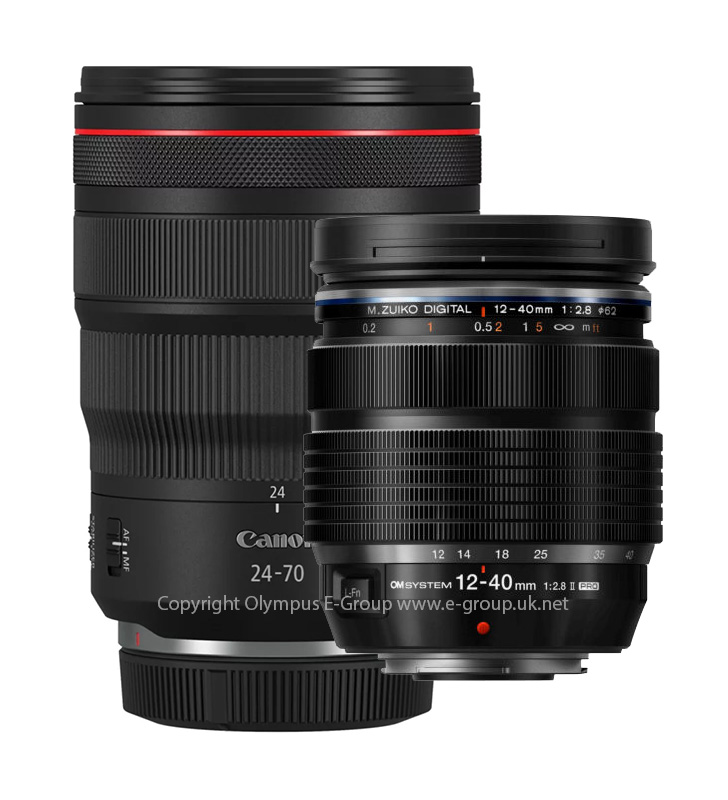
Canon (FF) RF 24-70mm f/2.8L IS USM vs. Sony (FF) FE 24-70mm f/2.8 GM II vs. Olympus (M43) m.Zuiko Pro 12-40mm f/2.8
Weight 900g vs. vs. 695g vs. 382g
Length 125.7mm vs. 119.9mm vs. 84mm
Diameter 88.5mm vs. 87.8mm vs. 69.9mm
Cylindrical storage volume* 773cm3 vs. 725cm3 vs. 322 cm3

Sony 35mm FE f/1.4 GM vs. Fuji (APS-C) XF 33mm f/1.4 R LM WR vs. Olympus (M43) ED 20mm f/1.4 m.Zuiko Pro
Weight 524g vs. 360g vs. 247g
Length 96mm vs. 73.5mm vs. 63.4mm
Diameter 76mm vs. 67mm vs. 61.7mm
Cylindrical storage volume* 435cm3 vs. 259cm3 vs. 190 cm3 

*A cylinder of the length and maximum diameter of the lens, representing a typical space required for storing the lens, not the volumetric size of the lens itself, which will be smaller.

There is no getting away from physics. A smaller sensor means the optical lens design required to cover a given scene, given the same brightness (f-number) will be more compact than the optics required for a larger sensor.

No matter how small you make the body, the lens on your large sensor setup will, likely, determine the size and weight you will need to carry around with you.

As the data, above, shows, APS-C format lenses are smaller and lighter than their Full Frame counterparts, but Micro Four Thirds lenses even smaller and lighter.

But sensor is important, isn’t it?

It’s true, a larger sensor should deliver lower noise, and, if you need it, lenses of similar f-stop will deliver less depth of field. In day to day normal use, these perceived limitations may not actually be so apparent. We’ll look at these issues in a future article.

But the message is clear – if you don’t want to carry bulky and heavy camera gear anymore, Micro Four Thirds is well worth considering. Lots of former FF and APS-C format photographers have done exactly that, and not looked back.

Posted on

A look at IP ratings for dust and water resistance in cameras and lenses

Right from the original Olympus E-1 back in 2003, Olympus has specialised in high-performance environmental sealing of its premium model system cameras. There are plenty of anecdotes that testify to the reliability of Olympus camera body and lens environmental sealing to keep dust and water at bay. But it’s only relatively recently that Olympus and, now, OM System have included an industry standard rating in their product specifications.

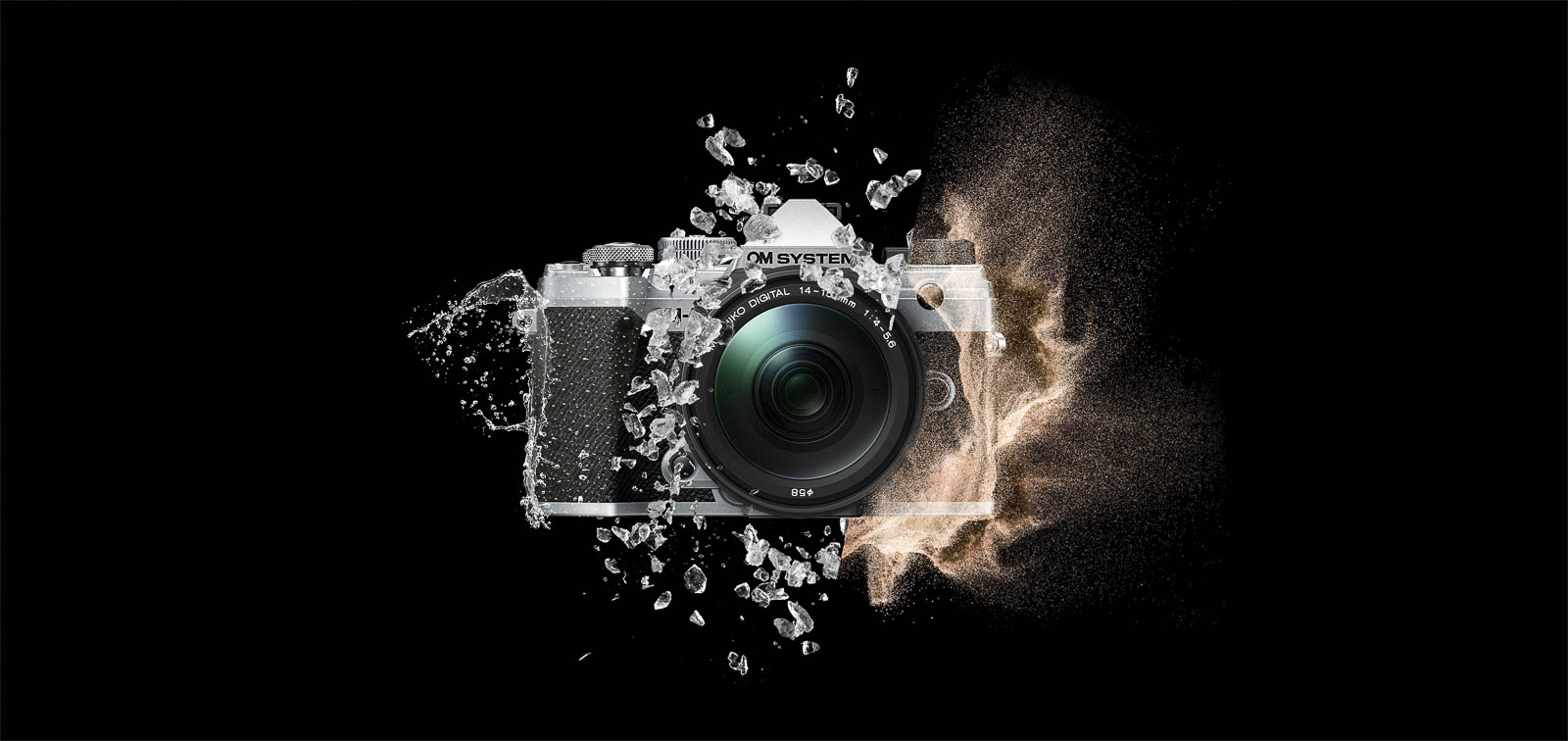
Most recent camera bodies and lenses that are deemed ‘dust and splash-proof’ have been rate to the IPX1 level standard. The latest OM-5 and some recent lenses are rated to IP53. ‘IPX1’ may, superficially, sound more impressive than ‘IP53’ but the latter is a more demanding level to attain. So, just what do IPX1 and IP53 mean?

To start with ‘IP’ mean Ingress Protection. ‘IP’ is the prefix in an Ingress Protection code that is defined by the International Electrotechnical Commission (IEC), a widely recognised international technical standards body.

An IP code has two suffix values. The first is a single character that relates to ‘solid particle protection’. The second value can be up to two characters and relates to ‘liquid ingress protection’.

Both suffix values can have an ‘X’ rating. This, basically, means that there is no information provided to meet any protection rating. You could say a rating of IPXX means the item rated has no protection against solid particle or liquid ingress. In practice, it might also mean that the product has not been tested to provide evidence that it passes a protection rating – even though it may have functioning protection.

IPX1

Olympus has used the IPX1 rating in its product specifications for lenses and camera bodies that feature environmental sealing for several years. But as described above, the ‘X’ means that the product is unrated for solid particle protection. We all know that Olympus sealed bodies and lenses since 2003 are pretty effective at resisting the ingress of dust, which is a recognised form of solid particle. So we can only assume that Olympus didn’t bother undergoing the required testing for this part of the IP rating.

After the X, comes ‘1’. This means the product resists the ingress of water dripping onto it. More precisely: “Dripping water (vertically falling drops) shall have no unsafe effect on the specimen when mounted in an upright position onto a turntable and rotated at 1 RPM.” The test simulates one millimetre of rainfall per minute over a duration of ten minutes.

IP53

With the new OM-1 and OM-5 camera bodies launched by OM System, and several of its new lenses, the IP specification is now IP53.

The ‘5’ means the product is ‘Dust protected’ but this is one down from the ‘6’ rating of ‘Dust-tight’. Rating 5 means: “Ingress of dust is not entirely prevented, but it must not enter in sufficient quantity to interfere with the safe operation of the equipment.”

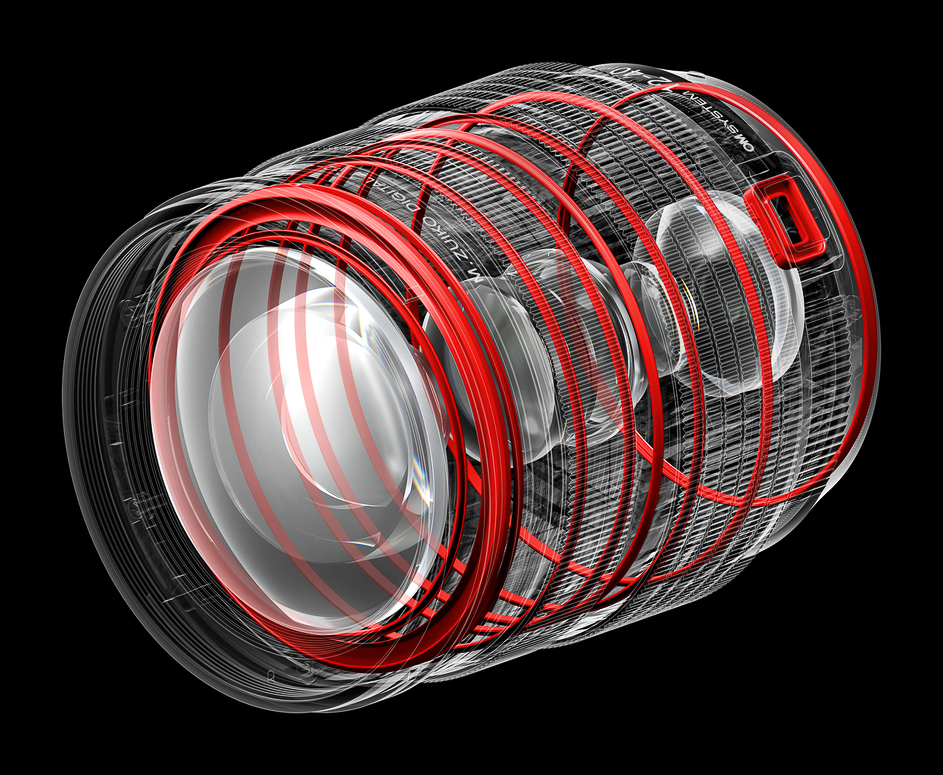
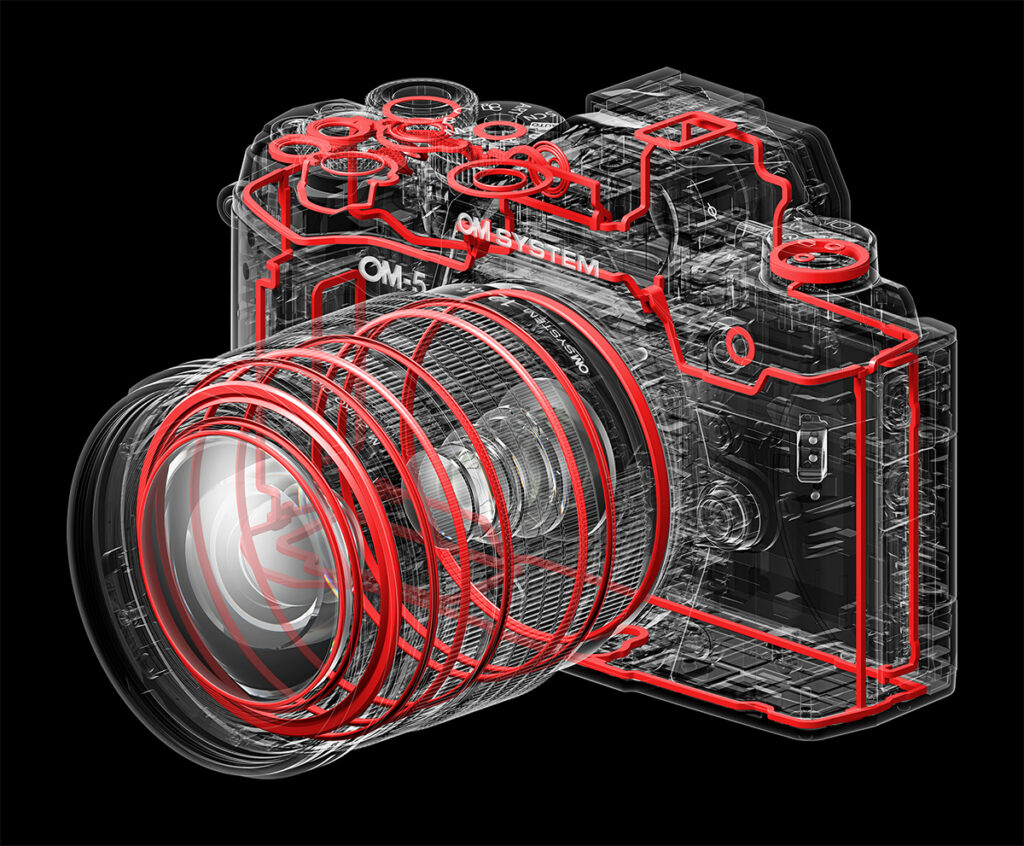
OM System OM-5 and 12-45mm f/4 Pro sealing

The second value, ‘3’, means that there is protection that can cope with water spraying onto the product. Interestingly, the next number up the protection performance ratings (4) refers to splash-resistance. It seems that neither Olympus, nor OM System have yet achieved this level of IP rating for water resistance, despite the widespread talk of ‘splash-resistant’ bodies and lenses.

The test regime to achieve a ‘3’ for liquid ingress is: “Water falling as a spray at any angle up to 60° from the vertical shall have no harmful effect, utilizing either: a) an oscillating fixture, or b) A spray nozzle with a counterbalanced shield. Test a) is conducted for 5 minutes, then repeated with the specimen rotated horizontally by 90° for the second 5-minute test. Test b) is conducted (with shield in place) for 5 minutes minimum.”

Better sealing or simply more testing?

It’s not clear whether the new OM-5 body, which shares an almost identical chassis with its predecessor, the Olympus E-M5 Mark III, has physically improved environmental sealing or not, despite having a superior IP53 rating compared to IPX1. It could simply mean that the product was submitted for, and passed, tougher tests to earn the superior rating.

Nevertheless, IP53 is a tangible and realistic affirmation of long-held claims by Olympus and, now, OM System. Interestingly, I found it difficult to find IP ratings in the specifications of other brand pro-spec cameras, even though these cameras do claim to be dust and water resistant.

Posted on

Welcome to the E-Group magazine and shop

Welcome to this new section of the Olympus UK E-System User Group website.

We’ll post the occasional article here to complement the main forum.

The other primary function of this part of the site is to manage fund-raising via an online shop. This should make the process of ordering and paying for goodies we have to offer a bit easier than before.

To start with we have the remaining Olympus miniatures and some odds and ends.

We will also be building up a selection of products you can order from Amazon, which will generate a small commission for us.

Watch for developments and improvements – to find this page directly just use the url magazine.e-group.uk.net.