Posted on

Don’t overlook Micro Four Thirds

Is the sensor size argument just a distraction

For some photographers, it would seem that the size of the sensor in their camera needs to be as large as possible. Full-frame cameras are, sort of, the bare minimum in terms of sensor size. Aren’t they? Not at all.

Olympus/OM System and Panasonic Lumix Micro Four Thirds photographers don’t think like that, and the smaller sensor their cameras depend on hasn’t prevented them from taking fantastic images since 2003.

So who has got it right? Are both camps deluding themselves. Absolutely not. Well, maybe. It all boils down to what you need from your gear. What is absolutely wrong is to dismiss either format without understanding their pros and cons.

The sensors

Full frame cameras are a legacy of the film era. The 36x24mm frame area is the same size as a typical 35mm film camera. A Micro Four Thirds (technically, just ‘Four Thirds’) sensor is a quarter of the area of a full frame sensor. Yes, it’s significantly smaller, but it’s still categorised as a large sensor. The sensors you find in, say, even some of the flagship smartphones, are much, much, smaller still.

Digital camera sensors are semiconductor integrated circuits, or chips. Micro Four Thirds sensors are relatively huge in the chip world. Full frame sensors are, however, behemoths.

Normally, many thousands of tiny chips are manufactured on a platter of silicon, called a wafer. Natural manufacturing defects mean that a percentage of these chips will be faulty, and discarded. The percentage yield of working chips is greater for smaller chips, and, naturally, you get more smaller chips per wafer. This is why the smaller a chip is, the cheaper it is to manufacture. Full frame sensors are significantly more expensive to make than Four Thirds ones.

Pros and cons – size matters

Full Frame sensors usually have a pixel pitch, or the area covered by each light sensitive photosite, that is very large. This means each image pixel is the product of more gathered light. This can translate into lower noise and greater dynamic range, which is the ability to record greater detail in extreme darkness, as well as extreme brightness. Both are plus points for fundamental image quality and mean that Full Frame can cope better with very extreme lighting conditions.

Four Thirds sensors, remember, are still large. These days, sensor technology has improved a great deal, meaning that the noise and dynamic range performance of Four Thirds sensors is better than some Full Frame sensors from, say ten years ago.

Smaller size and mass of Four Thirds sensors mean they work better when IBIS (In Body Image Stabilization) is used. Another advantage of their smaller size is that Four Thirds sensors can be read significantly faster, which makes higher continuous frame rate shooting possible, and this also helps with so-called computational photography modes.

Lenses, and depth of field

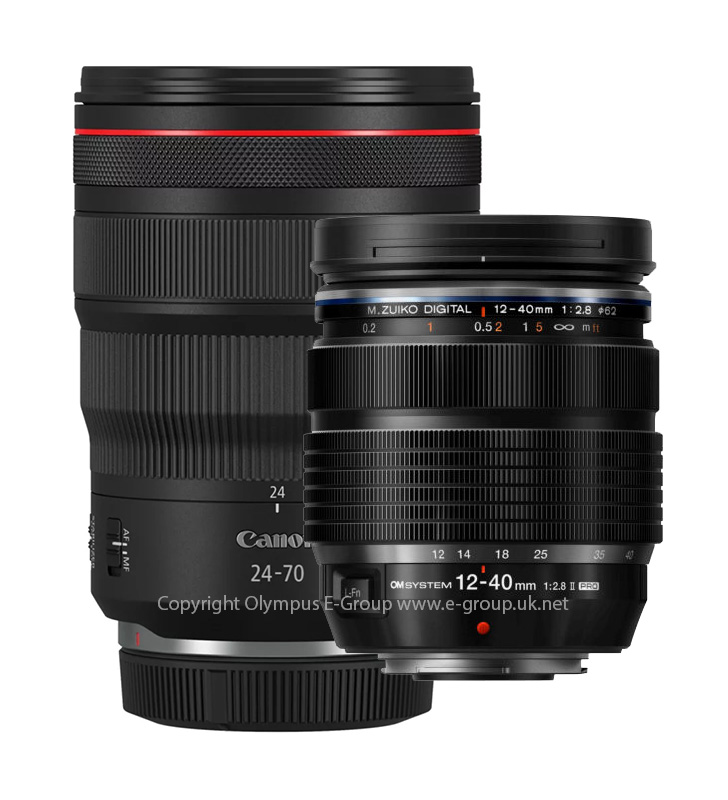
For a given field of view as a rule of thumb, a Full Frame lens will be about twice as large as a Micro Four Thirds lens. We have covered this in a separate article. This is a major factor if you want to travel light, or if, for other reasons, large and heavy lenses are impractical.

Now all the major camera marques have gone mirrorless, the physical size of camera bodies is pretty similar between FF and MFT, with a few exceptions. The primary difference is lens size and weight.

Depth of field is often topic of discussion when comparing FF and MFT. For the same brightness (aperture), a deeper distance in front of and behind the camera will be in sharp focus with MFT than with FF. Larger sensor advocates will dwell on the ability of FF to more easily deliver softer bokeh, or the effect of blurring the background. You can still achieve similar degrees of bokeh through various techniques – larger aperture lenses, using longer focal lengths and reframing, or now, very effectively, in post-processing.

It’s often forgotten that inadequate depth of field can be a headache when you want to get more of your subject in focus, in macro and landscape photography, for example. This may mean you have to stop your aperture down, meaning slower and slower shutter speeds to compensate for the lower brightness, and the consequents of risking more camera shake, or having to raise the ISO setting.

The bottom line

Olympus and OM System, Panasonic Lumix, and other MFT cameras, are not worse than their full frame counterparts. They are just different. If you aren’t primarily shooting for social media, Full Frame might be the better choice, but MFT images can still be printed very large. If you want or need to travel light, MFT is the way to go. It’s no good having a great set of FF gear that you are reluctant to lug around with you. This article could go into a lot more detail, but hopefully, you have started to get the picture.
Posted on

In defence of the new 150-600mm zoom from OM System

System 150-600mm f/5-6.3

Is this OM System’s most misunderstood lens?

There is a lot of nonsense flying around about OM System’s new ULTRA-telephoto zoom lens. And there are also some honest concerns. Indeed, my own feelings about the 150-600 have changed the more I have thought about this lens. So let’s delve in.

Perusing comments on our very own discussion forum, many of which reflect influencers and so-called experts on YouTube and other social media platforms, it’s clear to me that the new OM System m.Zuiko ED 150-600mm f.5-6.3, launched last Tuesday, is frequently misunderstood.

So the lens is based on a Sigma design

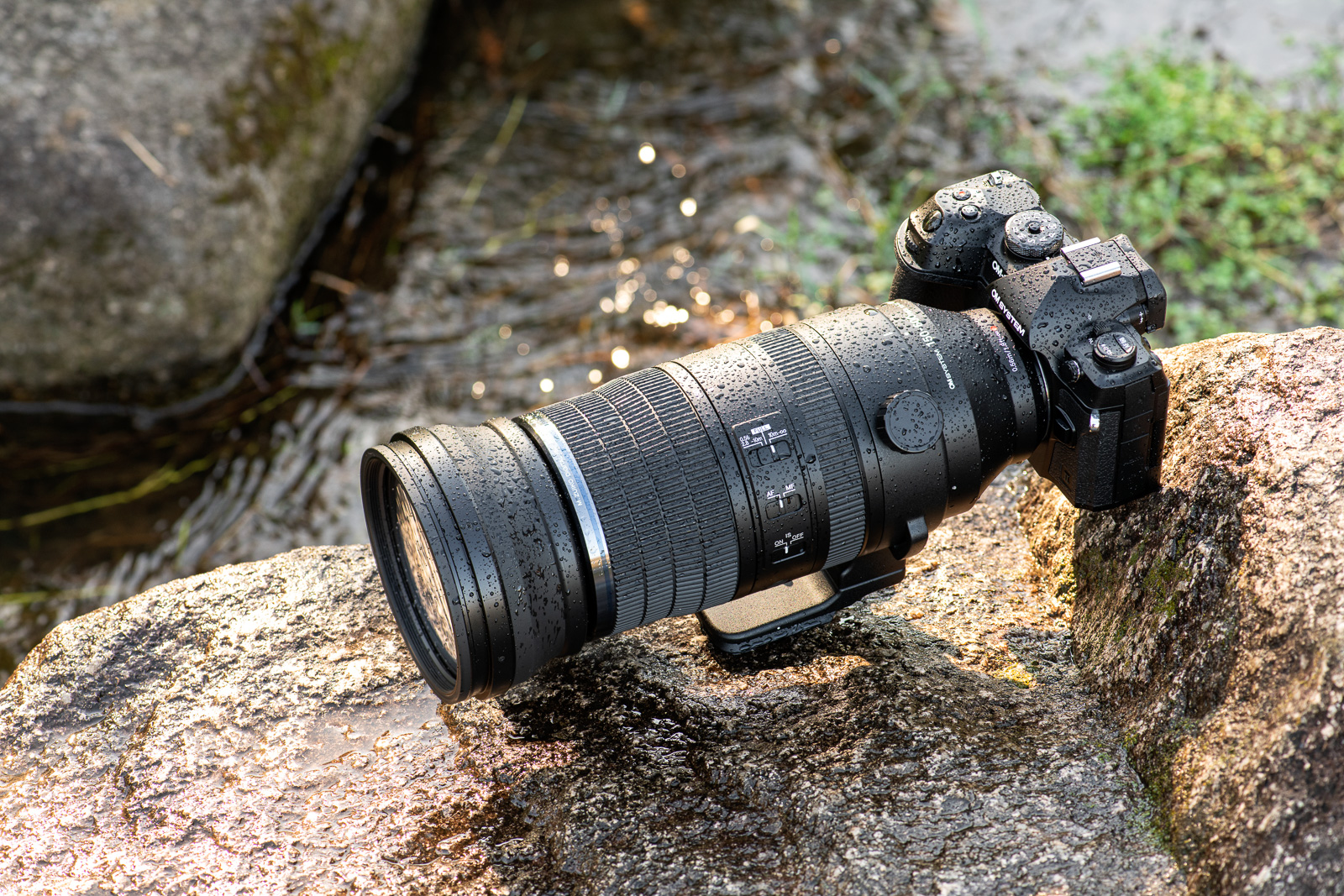
OM System won’t say anything about the provenance of the lens, but why should they? It’s not the first time a Micro Four Thirds lens with an Olympus or Panasonic Lumix brand has been designed and even made by Sigma. OEM manufacturing is a big part of Sigma’s business. The OM System 150-600 is very clearly a re-engineered Sigma 150-600mm f/5-6.3 DG DN OS | Sports optic. Its appearance, specifications, and dimensions, are all convincing evidence.

But this isn’t simple badge-engineering

The lens will have modified electronics and firmware to enable it to communicate with the Micro Four Thirds protocols for fly-by-wire autofocus and image stabilisation controls. Stabilisation, in particular, is an OM System industry-leading forté and the 150-600 gets the full-fat Sync IS treatment. This is the magic that enables the camera body’s IBIS (In Body Image Stabilisation) to synchronize in real-time with the lens’ own OIS (Optical Image Stabilisation) to maximise stabilisation. The system works across 5 axes and delivers up to 7 stops of added stability, as define by CIPA standards, at 150mm, and 6 stops at 600mm. With OIS on its own, you can get up to 5 stops, which is one stop better than Sigma’s own version of the lens.

There is no way of knowing for certain, without OM System and/or Sigma briefing us, but there might even be some optical modifications. The image circle for Four Thirds sensors is smaller and, perhaps, some fine-tuning has been done to enable the existing m.Zuiko MC-14 1.4x, and MC-20 2.0x teleconverters, to be optimally matched, but that’s just a guess.

This is not a re-warmed DSLR design

Sigma currently sells three 150-600mm f/5-6.3 lenses and they are all quite different. Two, were introduced ten years ago (2014) and were designed specifically for DSLR cameras. In August 2021 Sigma’s third 150-600 was launched; the brand new 150-600mm F5-6.3 DG DN OS, designed specifically for mirrorless cameras. Optical design, the engineering of the autofocus hardware, etc., were new. This is what the OM System 150-600 was based on.

But isn’t the OM System 150-600, therefore, an adapted full frame lens?

The simple answer is, yes. But that’s missing the point.

Just because the lens was originally designed with full frame (and APS-C) sensor cameras in mind, doesn’t mean it is unnecessarily large and heavy compared to a lens designed, from the ground up, for Micro Four Thirds. And neither does it mean it won’t perform well on a Micro Four Thirds body. Most importantly, the lens is a thoroughbred mirrorless design.

Anyway, are we comparing apples with apples?

Well, not really!

A 150-600mm lens fitted to a full frame camera is doing the same job as a 75-300mm lens fitted to a Micro Four Thirds camera. For the record, the OM System 75-300mm f/4.8-6.7 is  – OK I exaggerate – microscopic, compared to the 150-600.

On Micro Four Thirds, the 150-600 is doing the job of a 300-1200 on full frame! This is a completely different game to using a 75-300 on MFT. And you can even boost that to 600-2400 using an MC-20 converter.

So who is OM System aiming at with the 150-600?

My initial reaction was to suppose it would only be of interest to those that REALLY needed to get substantially closer to a subject than, say, using a 400mm lens. That would be quite a limited market.

But my thoughts on this have evolved. Olympus and OM System have been triumphant with the m.Zuiko 150-400mm f/4.5 Pro, the BWL (Big White Lens).  Users rave about its optical performance, Sync IS stabilisation, and supreme portability compared to lenses from rival systems. It also includes a built-in switchable 1.25x converter, also of excellent quality, so you can turn your 150-400 into a 188-500mm f/5.6 without removing the lens from the camera body.

But at £7K, the glorious 150-400 is basically a limited-edition lens affordable only to those few who can really afford it.

Until now, the only in-house alternative has been the m.Zuiko 100-400 f/5-6.3, which is affordable and a good performer, if not in the same league as the 150-400 Pro. But now we have the new 150-600. Yes, it’s twice the cost of a 100-400, but it’s almost a third of the cost of the 150-400 Pro. It’s a little brighter at matching focal lengths, too. If you need more than 400mm, you can just turn the zoom ring further – no need to stop and fit a converter to the 100-400.

The 150-600 also has a Pro lens feature, Sync IS, which the 100-400 doesn’t. But the 150-600 isn’t a Pro lens and it’s limited to 25 fps sequential shooting compared to 50fps for Pro lenses. But is that a huge drawback for most?

I automatically assumed the 150-600 would be far too heavy for hand-held photography, but it’s only 10% heavier than the 150-400 Pro. You do need to be fit, but I am sure the 150-600 can deliver, hand-held.

But what about the price?

Ah, the price. OM System has priced the 150-600 at double that the Sigma version of the 150-600 sells for. That is, undoubtedly, disappointing. I’ve argued that OM System might not be expecting to sell a big enough volume of the 150-600 to permit it to be commercially viable at a lower price. But the more I think about it, OM System could be pleasantly surprised – at the right price. I think the best we can hope for is that the lens sells better than hoped for and the price can be reduced over time.

Get the paparazzi interested!

I also have a fun suggestion for OM System – sell an OM-1 Mark II + 150-600 kit, with some teleconverters thrown in, at an attractive price, for the paparazzi. I reckon this is just what they have been waiting for!

I hope you found this article useful. As ever, I recommend you have a look at our friendly discussion forum dedicated to anyone interested in Olympus/OM System and compatible gear.

Posted on

Is the original OM-1 going to get some of the Mark II goodies?

OM System OM-1 Mark II

OM System needs to be clearer about this

OM System needs to keep an eye on a potential row that is brewing in part of its loyal customer base – users of the original Olympus OM-1.

That flagship camera was replaced, yesterday 30th January, by the OM System OM-1 Mark II, after only 2 years.

Pretty much unchanged on the outside, apart from OM System, instead of Olympus, branding, the Mark II is, according to the manufacturer, only different on the inside through the expansion of buffer memory for fast sequential shooting, and this has been doubled. The sensor, image processor, shutter, image stabilisation mechanics, viewfinder OLED, et al, are the same as its predecessor.

Nevertheless, the Mark II offers an attractive batch of functional improvements, thanks to improved software algorithms, and new code that adds new tools. These include:

  • An extra stop of darkness afforded by the Live ND digital neutral density filter mode.
  • The debut of a Live GND tool, which lets you apply a graduated Live ND filter effect to the image you are about to capture.
  • When using the camera’s High Res Shot mode, offering real-time aggregation of multiple, sensor micro-shifted, donor images to increase recorded resolution from 20 to 50, or even 80 megapixels, the recorded RAW file can now include 14-bits of tone instead of 12.
  • There’s improved AI training for the autofocus subject identification and tracking system, plus improved algorithms to increase the reliability of the AF system
  • A small but, for some, a much-appreciated tweak, is that you can now reprogram a button on the right hand side of the back of the camera to relocate the Menu button from the left side, enabling one-handed use.
  • OM System say that the focus stacking and focus shifting process now works faster – though it’s not clear if that’s improved algorithms again, or because the memory buffer is bigger.

Happy days! OM System has cleverly increased the performance and utility of the camera without needing to redesign and re-tool the chassis, and we assume that, internally, there is only a modified circuit board to accommodate the extra buffer RAM.

But doesn’t that mean the software-based improvements could work on the original OM-1, delivered via a firmware update?

Some irony is that Olympus was one of the pioneers of firmware updating via the Internet and every Olympus DSLR and mirrorless camera, over the last 21 years, has benefitted, for fixing bugs, improving compatibility with new lenses, and the like. But what about adding new features?

Yes you can!

Actually, yes! The original Olympus E-M1 added a long list of new functions with release 2.0 of its firmware, including keystone compensation, tethered shooting, Live Composite shooting mode, etc. Release 4.0 added even more, including focus stacking and focus bracketing. Other camera marques have also released major firmware updates that add functionality to their cameras.

So seasoned OM-1 owners can look forward to some of the software goodies developed for the OM-1 Mark II. Or can they?

OM System has not made a categorical statement regarding firmware updates for the original OM-1. I’ve heard from OM System representatives that there are ‘no plans’. Others have been told that the functional and performance improvements in the Mark II depend on the extra buffer memory it enjoys. But it’s all a bit vague.

Hope, expectation, logic, and reality are still in flux. Logic suggests that as so little of the digital electronics of the camera has changed, that the newly-coded Mark II functionality MUST work on the original OM-1. This is further amplified by hope and expectation, of course.

Certainty

We need certainty. Someone knows which of the following is correct:

Is it a) – at least some of the functionality is coming, but the OM-1 Mark II is the priority for now. Or is it b) – the new code can’t, technically, be adapted to the original OM-1, for X reasons.

Of course, there might be a c) – ‘we’re finished with the old OM-1, and though we could put the effort into updating older cameras with some of the new functionality, we aren’t going to, for commercial reasons’.

Naturally, I hope reality turns out to be a), but c) really is a possibility – OM System is a relatively small player and it needs to watch its costs much more carefully than its bigger competitors.

But my next question is – how much is goodwill worth to your existing customers, and can OM System afford to disappoint even some of them?

Update for a fee?

I’ve seen evidence that some OM-1 users could be persuaded to pay a sensible fee, whatever that might be, for access to some of the Mark II functionality.

But getting back down to earth, the fact is that we do need more clarity from OM System. If there is definitely no chance at all, ever, of any of the new functionality being provided to users of the original OM-1, then so be it – but do tell us, without ambiguity.

Discuss this article?

The heart of our site is our friendly discussion forum, dedicated to users of Olympus, OM System, and other users of compatible Four Thirds and Micro Four Thirds gear. Check out the discussions here.